The Socioeconomic Impact of Grab Indonesia's Digital Ecosystem
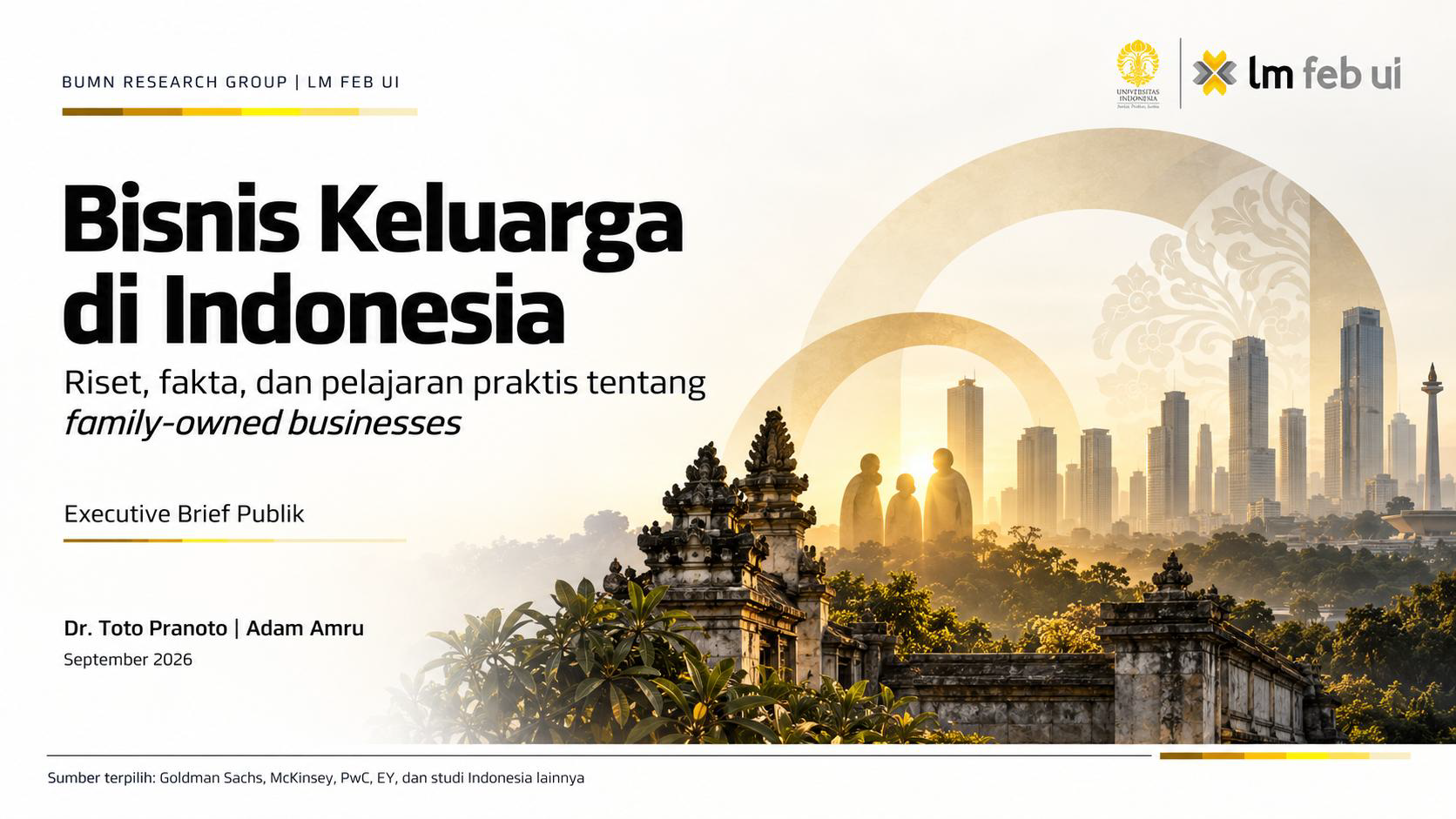
Family-Owned Businesses in Indonesia: The Backbone of the Economy and the Challenge of Succession
Authors :
Toto Pranoto,
Adam Faiana Amru,
LM FEB UI,
Topic : Family Business, Corporate Governance, Succession Planning, Indonesian Economy, Business Strategy
Family-owned businesses are undeniably the engine of the global economy. According to data synthesized by the BUMN Research Group (BRG) LM FEB UI, family businesses contribute up to 70% of global GDP and 60% of global employment. Furthermore, large family businesses tend to achieve a +1.5 percentage point higher operating margin compared to their non-family peers, driven by their long-term orientation, disciplined finances, and strong commitment to family reputation.
However, sustainability across generations remains remarkably fragile. BRG's analysis reveals that while 30% of family businesses survive the transition from the first to the second generation, only 12% make it to the third.
In Indonesia, the dominance of family businesses is even more pronounced. It is estimated that approximately 95% of businesses in the country are family-owned or family-run. Based on the PwC Global Family Business Survey 2025, 51% of Indonesian respondents view family loyalty and long-term relationships as their core strengths, yet 63% cite economic volatility as their most pressing issue. Interestingly, Indonesian family businesses are relatively more cautious towards Artificial Intelligence (AI) compared to global trends, and only 25% consider their businesses to be truly agile. Notably, major Indonesian corporations like BCA and Gudang Garam have secured their positions in the EY Global 500 Family Business Index 2025.
Despite their strengths, these businesses often face severe "Critical Failure Factors" (CFF). The BRG brief highlights six major patterns that frequently destroy continuity: succession vacuums (where a dominant founder leaves without a clear successor), unresolved family conflicts, fragmented ownership without clear rules, nepotism that overrides meritocracy, the mixing of family and corporate cash, and overly slow market adaptation. As noted by the researchers, many family businesses fail not from a lack of opportunity, but because these points of failure emerge simultaneously and are left unaddressed for too long.
To transition from a family firm to an enduring institution, five key governance decisions must be clearly defined: who manages the business, who owns the shares, who has access to capital, who holds control, and who has the right to work in the business. Global giants like Walmart, Mars, and BMW have demonstrated that strong family control can coexist with high professionalization and immense scale. The ultimate lesson is clear: ownership, control, and management must be separated, and governance must be formalized in writing, not just through oral tradition.
For a deeper dive into the governance structures, trade-offs, and practical lessons for Indonesian family businesses, download the complete Executive Brief below.