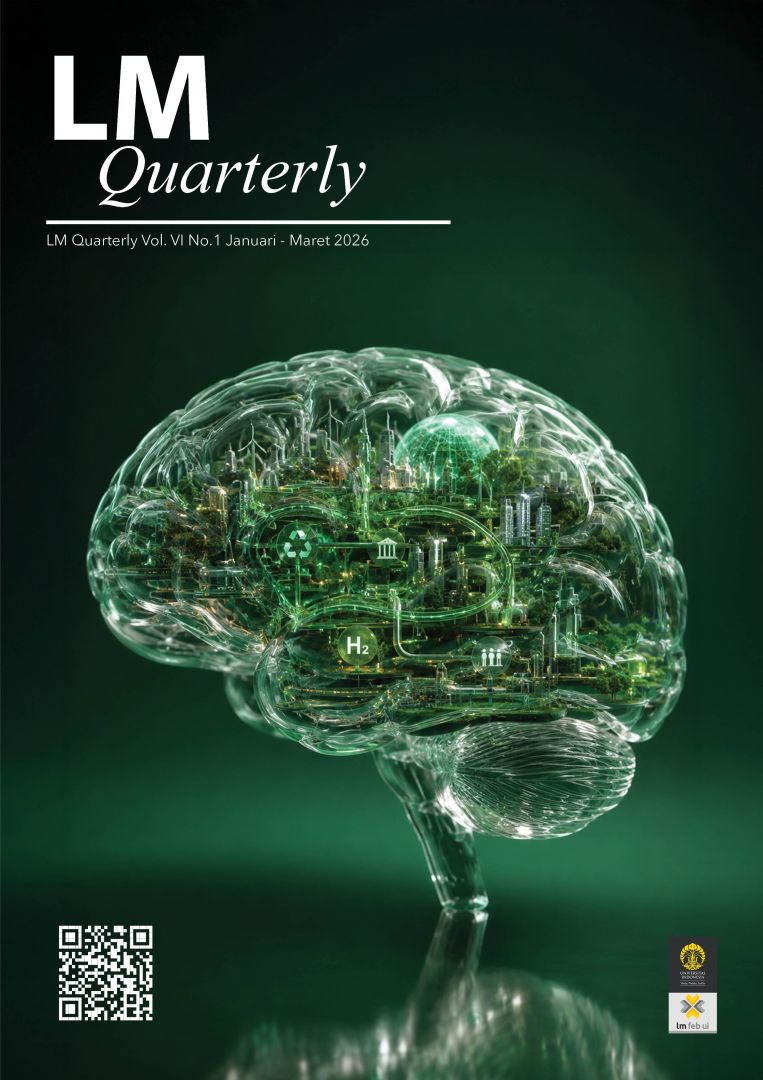
LM Quarterly Vol. VI No.1 January–March 2026
Loan-to-Value and Housing Accessibility
Loan-to-Value (LTV) policy is positioned not merely as a financial relaxation instrument, but as part of a broader housing ecosystem strategy. Sustainable housing accessibility requires integration between financing policy, subsidies, affordability, and supply-side readiness.
Waste-to-Energy and Strategic State Intervention
Waste-to-Energy (WtE) development requires institutions capable of balancing investment logic, public service obligations, and long-term governance. Danantara is positioned as a strategic actor capable of bridging infrastructure financing complexity and environmental transformation.
Beyond Profit and Sustainable Growth
Modern organizations are encouraged to move beyond short-term profitability toward impact-oriented growth. Sustainability is framed not as a branding exercise, but as a strategic foundation for resilience, governance quality, and long-term competitiveness.
Green Sukuk and Impact Efficiency
Green Sukuk allocation must be evaluated not only from financing volume, but also from efficiency and measurable sustainability outcomes. Data Envelopment Analysis (DEA) is introduced as an approach to assess impact effectiveness across sustainable sectors.
Circular Economy as Business Advantage
Circular Economy implementation in MSMEs demonstrates that environmental responsibility can become a source of operational efficiency and competitive advantage. Waste management is transformed from a cost center into a strategic business opportunity.
ESG, Greenwashing, and Public Risk
Weak ESG accountability creates risks of greenwashing and declining public trust. NO-GREEN LIE is introduced as a market discipline mechanism to strengthen governance transparency and institutional accountability.
Innovation as Organizational Capability
Innovation is no longer understood solely as technological invention, but as an organizational capability to manage creativity, adaptation, and structural transformation in rapidly changing environments.
Post-Retirement Ecosystem and Social Resilience
Retirement systems are evolving beyond formal protection schemes into broader economic ecosystems. Institutions such as Bank Mandiri Taspen play an increasingly important role in supporting financial access, productivity, and quality of life in post-retirement stages.